Search
Search projects, tokens and protocols by name or address
Home
The CROPS guide




 5 projects
Protocols that hold to CROPS: Censorship resistance, Openness, Privacy and Security.
Read our mandate
What ETHBEAT stands for and how we work.
Privacy
Value locked$780.41 M−27.0%1y
Deposits$3.62 B+17.8%1y
Top protocols
PrivacyTVL·7dVol 30d- 1Tornado CashPrivacy assessment
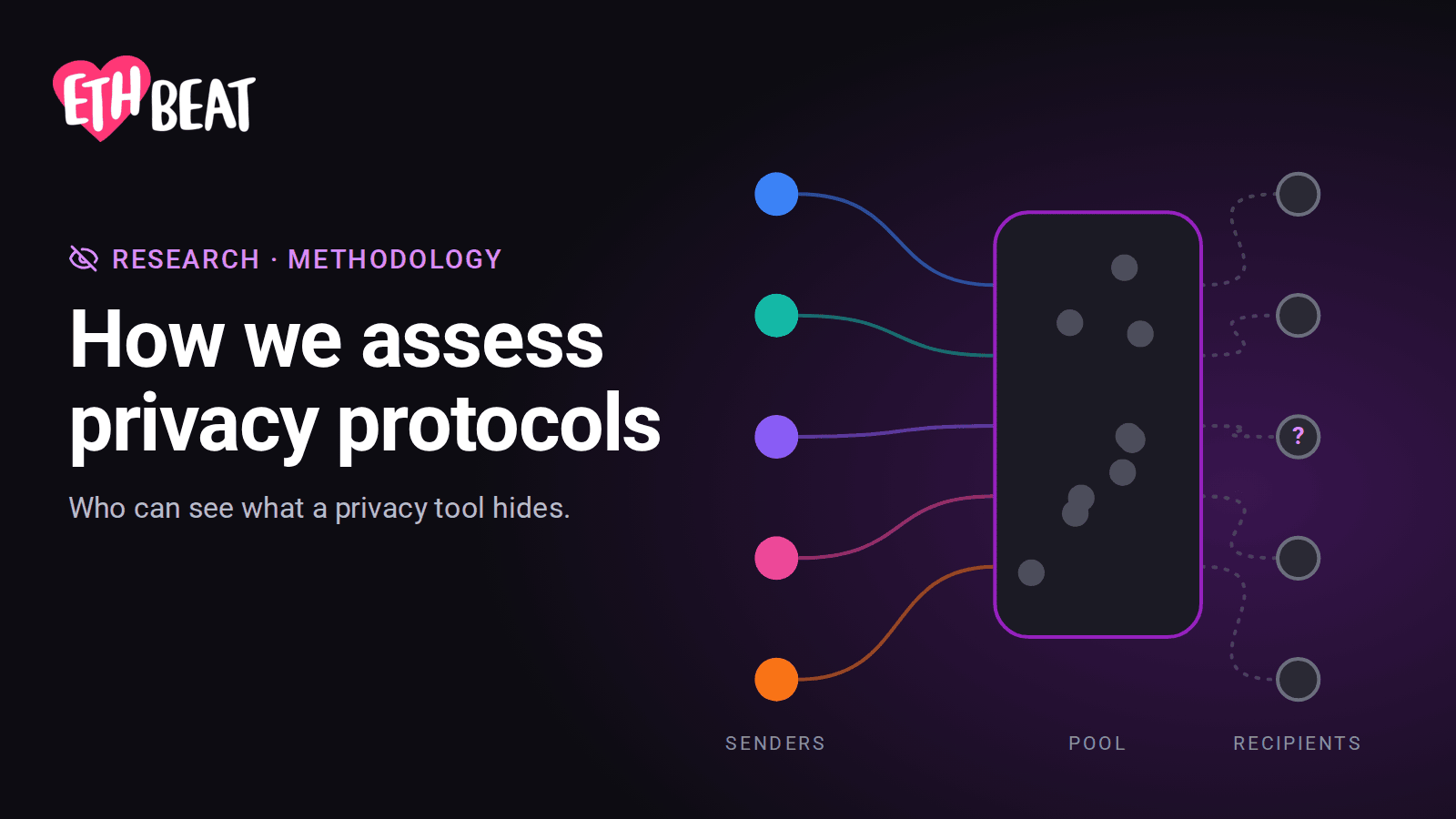
- Public observer: Private. Each pool has one fixed amount and no in-pool transfers, so every withdrawal spends exactly one deposit.
- Chain analyst: Private. A relayed withdrawal hides among all unspent deposits of its pool, the anonymity set, which differs sharply between pools.
- Network observer: Private. The app downloads every deposit of a pool, so over an IP-hiding route its services learn the pool but not the user's note.
- Privileged insider: Private. The pools cannot be paused, upgraded or made to reveal anything.
- Future adversary: At risk. Whoever breaks elliptic-curve cryptography can test whether a given deposit could fund a withdrawal, since commitments use a Pedersen hash on an elliptic curve.
- 2
 RailgunPrivacy assessment
- Public observer: Private. Everything inside the pool is hidden, including which shield funds which unshield.
- Chain analyst: Private. The candidates for an unshield are the shields of the same token.
- Network observer: Private. With a local node as direct endpoint for reads, RailOxide keeps Ethereum reads local and sends the rest over built-in Tor.
- Privileged insider: Private. Only the user holds viewing keys, and DAO upgrades wait 7 days.
- Future adversary: At risk. Whoever breaks elliptic-curve cryptography decrypts every note sent to a 0zk address they know.
- 3
 Privacy Pools v1Privacy assessment
- Public observer: Private. A zero-knowledge proof hides which approved deposit a withdrawal spends.
- Chain analyst: Private. A relayed withdrawal of a common amount hides among all approved deposits of its pool.
- Network observer: Private. The website works in Tor Browser and scans every pool whole, matching notes locally without revealing the user's deposits to third parties.
- Privileged insider: At risk. The ASP postman can publish a new approved list at any time with no delay, and withdrawals must prove against the latest one.
- Future adversary: Private. Nothing encrypted is written onchain and commitments are Poseidon hashes, so whoever breaks elliptic-curve cryptography recovers nothing from the chain.
- 4
 Umbra CashPrivacy assessment
- Public observer: Private. Each payment goes to a fresh stealth address, and only the recipient's viewing key shows whose it is.
- Chain analyst: Private. Any of the 11,983 registered recipients could be behind a stealth address.
- Network observer: At risk. The hosted app checks the payee's address with its Alchemy RPC seconds before each payment, so timing ties the payee to the payment.
- Privileged insider: At risk. The hosted app gives the operator the user's wallet address on every scan and withdrawal address in the same session.
- Future adversary: Exposed. Whoever breaks elliptic-curve cryptography matches every past payment to its registered recipient from chain data alone.
- 5
 Privacy Pools v2Privacy assessment
- Public observer: Private. A zero-knowledge proof hides which approved notes a withdrawal or transfer spends, and a transfer publishes only encrypted notes.
- Chain analyst: At risk. A note's label passes to every later payee, and the ASP update that first approved it often leaves one candidate deposit.
- Network observer: At risk. When 0xbow's registry feeds fail, the default RPCs, led by Alchemy under 0xbow's key, receive the account right before its withdrawal.
- Privileged insider: At risk. The ASP postman can publish a new approved list at any time with no delay, and every private spend must prove against the latest one.
- Future adversary: Exposed. Every registered account's viewing public key sits in the Keystore, so whoever breaks elliptic-curve cryptography decrypts every note ever sent to it from the chain.
Layer 2s
Value secured$26.86 B−34.3%1y
Activity/UOPS2.28 K−48.5%1y
Top rollups
RisksStageTVS·7dUOPS- 1
 Base ChainRisk analysisStage 1$13.17 B116.40Sequencer FailureSelf sequenceState ValidationFraud proofs (1R, ZK)Data AvailabilityOnchainExit WindowNoneProposer FailureSelf propose
- 2
 Arbitrum OneRisk analysisStage 1$8.57 B17.99Sequencer FailureSelf sequenceState ValidationFraud proofs (INT)Data AvailabilityOnchainExit WindowEmergency: NoneRegular: 10dProposer FailureSelf propose
- 3
 OP MainnetRisk analysisStage 1$1.31 B21.57Sequencer FailureSelf sequenceState ValidationFraud proofs (INT)Data AvailabilityOnchainExit WindowNoneProposer FailureSelf propose
- 4
 MantleRisk analysisStage 0$1.04 B0.37Sequencer FailureSelf sequenceState ValidationValidity proofs (ST, SN)Data AvailabilityOnchainExit WindowNoneProposer FailureCannot withdraw
- 5
 LighterRisk analysisStage 0$940.81 M2.08 KSequencer FailureForce via L1State ValidationValidity proofs (SN)Data AvailabilityOnchain (SD)Exit WindowNoneProposer FailureUse escape hatch
Ethereum
Blobs liveBlob data·96.7% by L2s1.39TiB+18.7%1y96.7% by L2s
Activity/UOPS24.53+36.5%1y
Read our mandate
What ETHBEAT stands for and how we work.












Interop
Last 24hVolume$1.10 B
Transfers76.58 K
Active routes156

Top route Hyperliquid→Arbitrum One$159.00 M
Top protocols
Volume- 1
 CCTP v2$523.36 M
- 2
 LayerZero$254.44 M
- 3
 CCTP v1$72.29 M
- 4Hyperliquid$47.67 M
- 5Base Canonical$40.61 M




Volume$1.10 B
Transfers76.58 K
Active routes156
Top protocols
Have a question?
Ask about our data, provide feedback on our frameworks, or request research into a new project.